
RTK vs GPS for Agriculture
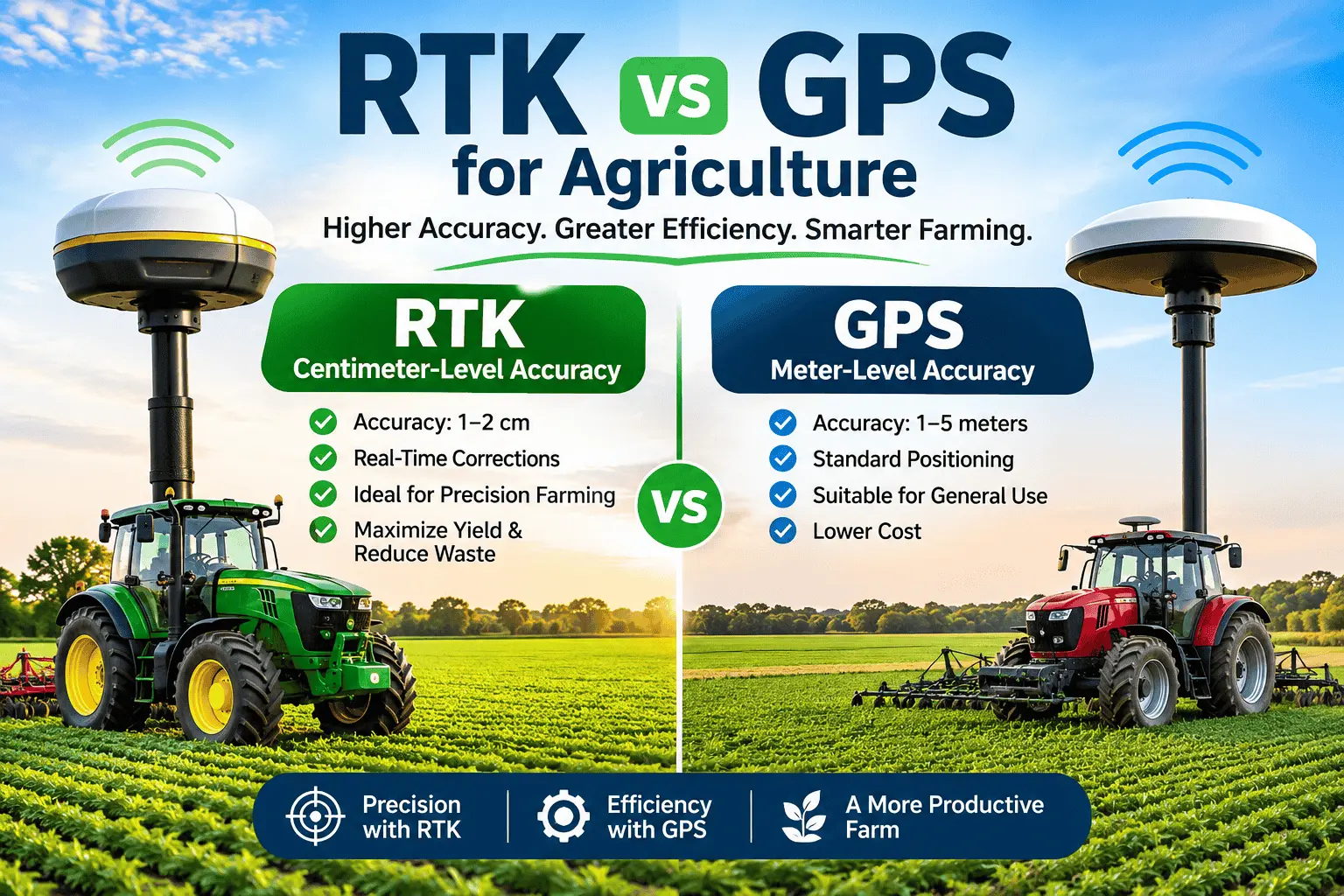
Every guidance system on a farm starts with satellite positioning, but "GPS" covers several very different levels of accuracy. Plain GPS can be off by a metre or more, while RTK holds a tractor to within a few centimetres, pass after pass and season after season. This guide explains the difference between GPS and RTK in agriculture, the correction options in between, and how to choose the right accuracy for your work.
GPS, GNSS and RTK: What the Terms Mean
- GPS is the American satellite navigation system. In everyday farm language, "GPS" is used for any satellite positioning.
- GNSS (Global Navigation Satellite System) is the correct umbrella term. It covers GPS, Europe's Galileo, Russia's GLONASS and China's BeiDou. Modern agricultural receivers use all four at once, so they see more satellites and keep a stable position near trees, buildings and hills.
- RTK (Real-Time Kinematic) is not a separate satellite system. It is a correction method that makes GNSS positioning accurate to the centimetre.
Why Plain GPS Is Not Accurate Enough
A GNSS receiver works out its position from the time signals take to arrive from each satellite. On the way, the signals are slowed by the atmosphere, and small errors in satellite orbits and clocks add up. On its own, a receiver is typically accurate to around one to a few metres, and the position drifts over time. That is fine for finding a field on a map, but not for driving parallel passes with a sprayer, a drill or a mower.
The Correction Options, From Basic to RTK
| Method | Typical accuracy | Repeatability | What you need |
|---|---|---|---|
| Uncorrected GNSS | 1 m or more | Poor, drifts | Receiver only |
| SBAS (EGNOS in Europe, WAAS in North America) | Decimetre level | Drifts over the day | Free satellite signal |
| Satellite correction services (PPP) | A few centimetres to a decimetre, after a start-up period | Good | Paid subscription |
| RTK | Centimetre level | Repeatable year to year | Own base station or RTK network |
The figures are typical ranges; real results depend on the receiver, the sky view and the conditions on the day.
How RTK Works
RTK uses two receivers. The first is a base station placed at a fixed point whose position is known exactly. Because the base knows where it really is, it can measure the error in the satellite signals at that moment. The second receiver is the rover on the tractor, sprayer or mower. The base sends its correction data to the rover many times per second, and the rover removes almost all of the error from its own position.
The corrections reach the rover in one of two ways:
- By radio from your own base station. This works without mobile coverage and has no subscription cost. Range depends on the radio power, antenna height and terrain.
- Over the mobile network (NTRIP) from a network of reference stations run by a provider. This needs mobile data in the field and usually a subscription.
RTK vs GPS: Which Do You Need?
SBAS or basic GPS is usually enough for:
- Spreading fertiliser and lime
- Broadacre spraying where small overlaps are acceptable
- Primary tillage and stubble cultivation
- Mapping field boundaries roughly
RTK is the right choice for:
- Planting and drilling, especially row crops such as maize, sugar beet and vegetables
- Strip-till and controlled traffic farming, where the same wheel tracks are used every year
- Mechanical weeding and hoeing close to the crop row
- Bed forming and ridging
- Land levelling and drainage, which also needs accurate height
- Robotic mowers and line markers, which navigate without boundary wires
The deciding question is repeatability. If you need to come back to exactly the same line tomorrow, next month or next season, you need RTK.
Your Own Base Station or an RTK Network?
| Own RTK base station | RTK network (NTRIP) | |
|---|---|---|
| Running cost | No subscription | Usually an annual subscription per receiver |
| Mobile coverage needed | No (radio link) | Yes, in every field |
| Coverage area | Around the base, limited by radio range | Wherever the network has stations |
| Machines served | All rovers within range, no extra fee | Each receiver needs its own access |
| Best for | Farms with fields close together, several machines, weak mobile signal | Contractors working over a wide area with good mobile coverage |
For a single farm with several machines, an own base station often pays for itself because there is one purchase instead of a subscription for every tractor and mower.
RTK Base Stations Available From CMC SmartFarm
- FJD V1 Base Station – a portable RTK base station that sets up quickly in the field, for single farms and contractors who move between sites.
- FJD N20 Fixed High Power GNSS Station – a permanently mounted station with a high-power radio for wider coverage around the farm.
- FJD Trion™ N10 CORS System – a continuously operating reference station for running your own correction network.
Each one works with FJD rovers such as our tractor autosteer systems, the MS100 Mower Kit and the robotic lawn mowers.
Quick Checklist Before You Choose
- List the jobs you want to guide and the accuracy each one needs.
- Check mobile coverage in your fields if you are considering an RTK network.
- Measure the distance between your furthest fields to judge whether one base station can cover them.
- Count the machines that will use corrections; more machines favour an own base station.
- Plan where the base can be mounted with a clear view of the sky and power available.
Buy an RTK Base Station
CMC SmartFarm sells FJD RTK base stations, GNSS receivers and autosteer systems online with prices in euros, wholesale and dealer pricing, and delivery from Germany across Europe and worldwide. Compare the RTK base stations for agriculture, read how tractor autosteer works, or contact us for a quotation.