
How Tractor Autosteer Works
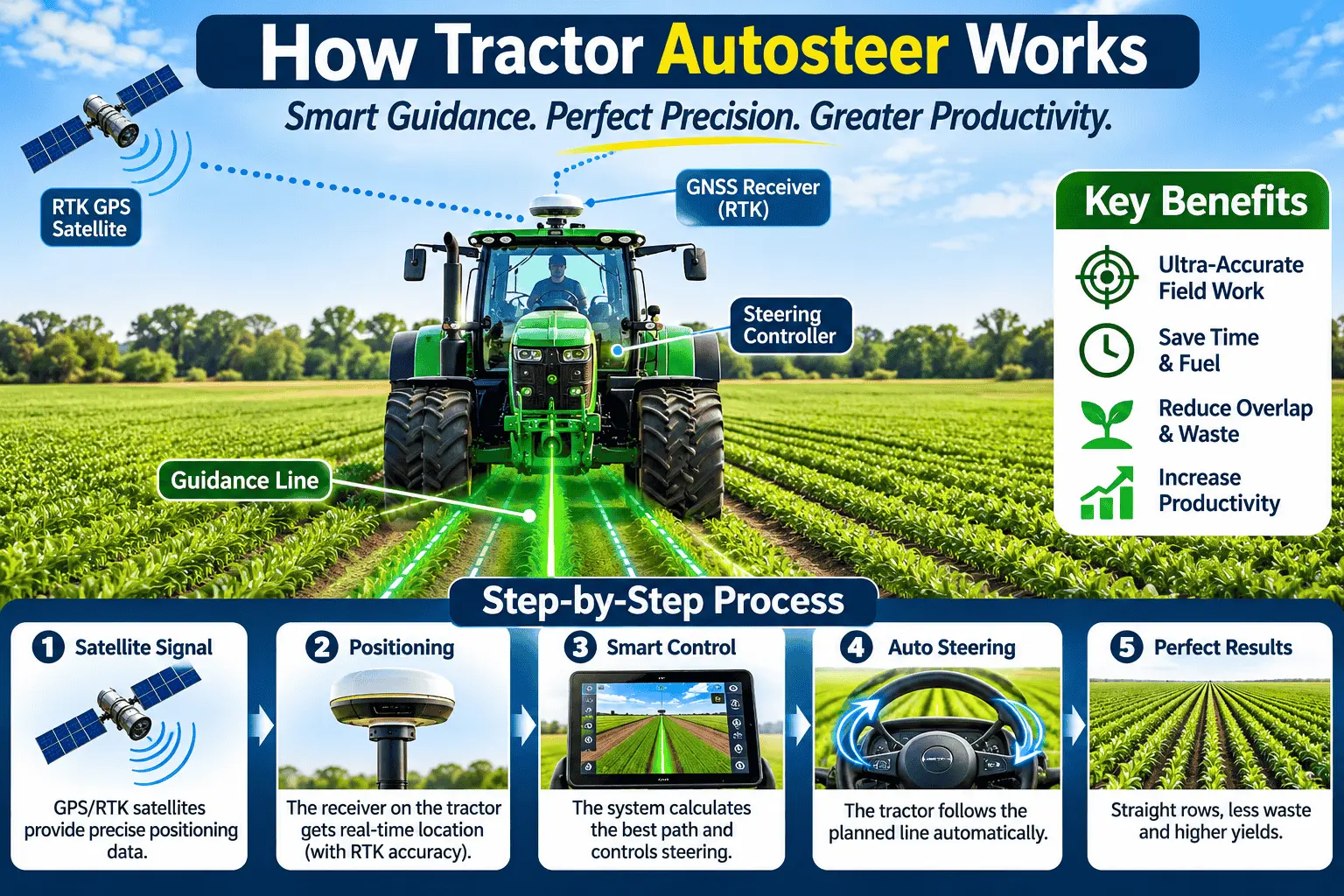
Tractor autosteer lets a tractor drive itself along a planned line while the operator manages the implement, the headlands and everything else that needs a person. It works by combining satellite positioning, a correction signal, a terminal in the cab and a steering unit that turns the wheels. This guide explains how each part works, how accurate the different correction methods are, and what to check before you buy a tractor autosteer system.
What Is Tractor Autosteer?
Tractor autosteer, also called auto steering or GPS steering, is a system that controls a tractor's steering automatically so it follows a guidance line across the field. The operator still drives the tractor in the sense that matters: they start and stop it, set the speed, lift and lower implements and turn at the headland. What the system takes over is the hardest part of field work to do well for hours at a time: keeping every pass exactly parallel to the last one.
Autosteer is different from a simple guidance system. A guidance system, such as a lightbar or a guidance-only display, shows the driver where to steer but leaves the steering wheel in the driver's hands. An autosteer system turns the wheels itself.
The Four Parts of an Autosteer System
Almost every GPS autosteer system for tractors is built from the same four parts.
1. GNSS antenna and receiver
The antenna, usually mounted on the cab roof, receives signals from satellite navigation systems such as GPS, Galileo, GLONASS and BeiDou. The receiver works out the tractor's position many times per second. Using several satellite constellations at once keeps the position stable when trees, buildings or hills block part of the sky.
2. Correction signal
Satellite positioning on its own is only accurate to around a metre or more, which is not enough for row crops or controlled traffic. A correction signal removes most of that error. The method used decides how accurate the whole system is; it is covered in detail below.
3. Terminal (display)
The terminal in the cab is where the operator sets up fields, creates guidance lines and engages autosteer. It shows the tractor's position on the line, the deviation from it, and the area already covered. Modern terminals also record work so it can be reviewed later or shared with farm management software.
4. Steering unit
The steering unit physically turns the wheels. There are three common types:
- Electric steering wheel – the original steering wheel is replaced by a motorised wheel that turns the steering column. It fits most tractors, including older models, and can be moved between tractors. Examples are the FJD AT2 Auto Steer System and the AT2 Lite.
- Hydraulic valve – a valve is connected into the tractor's steering hydraulics and steers without turning the wheel. It gives high steering force for large tractors and heavy work. See the FJD Hydraulic Autosteering Kit.
- Steer-ready connection – many newer tractors leave the factory prepared for autosteer. A steer-ready system, such as the FJD AS2, connects to that preparation instead of adding its own motor or valve.
How Autosteer Works, Step by Step
- Set up the field. The operator creates or loads a field on the terminal and records its boundary, often by driving around it once.
- Create a guidance line. The most common is an A-B line: the operator marks point A at one end of the field and point B at the other, and the system creates parallel lines across the whole field spaced at the implement width. Curved lines and pivot circles work the same way.
- Engage autosteer. Near the start of a line, the operator presses the engage button. The system calculates the difference between where the tractor is and where the line is, many times per second.
- Correct continuously. The steering unit makes small corrections to keep the tractor on the line. Terrain compensation, using tilt and motion sensors, corrects for the antenna leaning on slopes and bumps, so the implement stays on line, not just the cab roof.
- Turn at the headland. At the end of the pass, the operator disengages, turns, and re-engages on the next line. The terminal shows which line is next and how far the tractor is from it.
RTK, SBAS and Other Corrections: How Accurate Is Autosteer?
Accuracy is usually described as pass-to-pass accuracy: how closely one pass lines up with the next a few minutes later. The correction method decides it:
| Correction | Typical accuracy | Best for |
|---|---|---|
| No correction | Around 1 m or more | Not suitable for autosteer work |
| SBAS (e.g. EGNOS in Europe) | Decimetre level | Broadacre spraying, spreading, tillage |
| RTK | Centimetre level, repeatable year to year | Planting, row crops, strip-till, controlled traffic |
RTK, short for real-time kinematic, compares the satellite signals at the tractor with those received at a fixed reference point whose position is known exactly. The difference is sent to the tractor as a correction, by radio or over the mobile network. The reference point can be your own RTK base station, such as the FJD V1 Base Station, or a network of stations run by a service provider. With your own base station there is no subscription and no dependence on mobile coverage.
Benefits of Tractor Autosteer
- Less overlap. Without autosteer, drivers leave a safety overlap on every pass to avoid gaps. Removing most of it saves seed, fertiliser, spray and fuel.
- Fewer gaps and misses. Even coverage means fewer untreated strips and more even crops.
- Less operator fatigue. Holding a straight line for hours is tiring. With autosteer, the driver can watch the implement and work longer days and at night with less strain.
- Repeatable lines. With RTK, the same lines can be used every season, which is the basis of controlled traffic farming and strip-till.
- Better records. The terminal records where work was done, which helps with planning and documentation.
What to Check Before You Buy
- Your tractor. Check the make, model and year, and whether it is steer-ready. This decides between an electric wheel, a hydraulic kit or a steer-ready connection.
- The accuracy you need. Spraying and spreading can work with SBAS; planting and row crops need RTK.
- Your correction source. Decide between your own base station and a correction network, and check mobile coverage in your fields if you choose a network.
- Installation. Electric wheel kits are the simplest to fit; hydraulic kits need hydraulic work. Plan who will install and calibrate the system. CMC SmartFarm supplies equipment only, so installation is done by the buyer or a local technician.
- Extras you may want. ISOBUS for implement control, section control for sprayers, or a camera to watch the implement. See our accessories.
Buy a Tractor Autosteer System
CMC SmartFarm sells FJD tractor autosteer systems, RTK base stations and accessories online, with prices in euros, wholesale and dealer pricing, and delivery from Germany across Europe and worldwide. Compare the full range of tractor GPS autosteer systems for sale, or contact us with your tractor model for a quotation.