

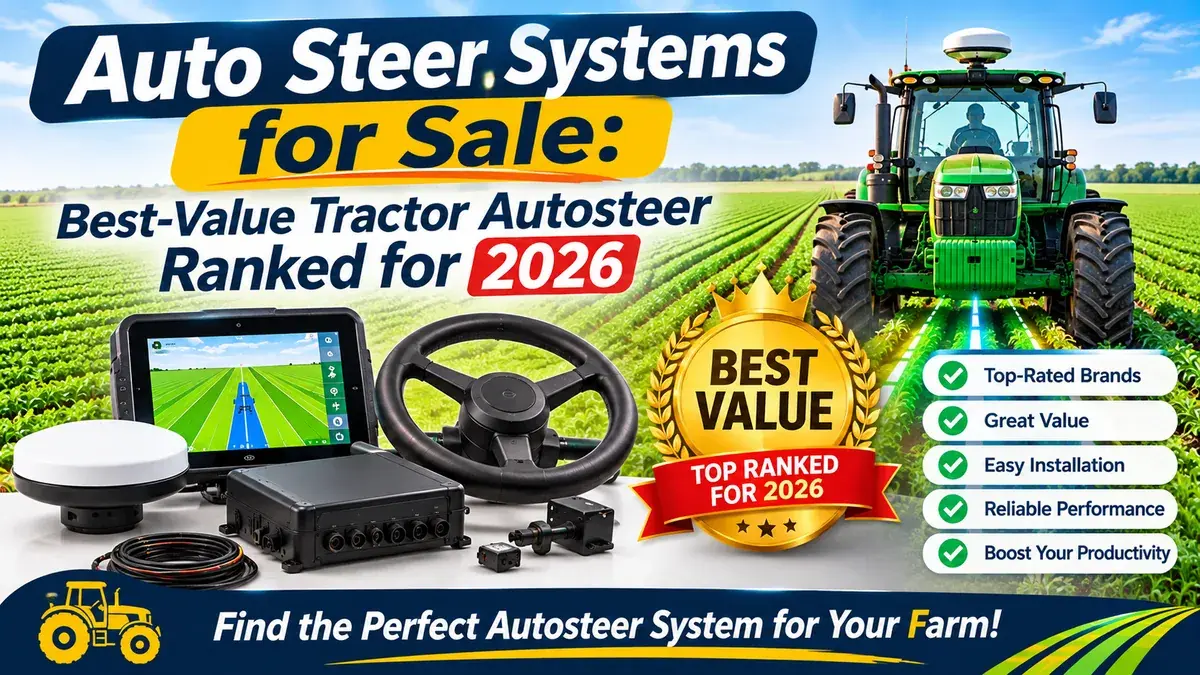
Auto Steer Systems for Sale: Best-Value Tractor Autosteer Ranked for 2026
If you are shopping for an auto steer system for sale in 2026, the hardest part is not the price tag — it is working out which system actually earns its keep on your farm. Input costs are up, margins are tight, and a steering system is a multi-year investment in your equipment, not an impulse buy.
This guide ranks the main auto steer systems on the market by real-world value: what you get per euro, across mixed fleets, over several seasons. We sell FJDynamics systems, so we will be upfront about where they lead — but we will also tell you exactly where John Deere, Trimble and Ag Leader are the smarter choice.
What to look for when buying an auto steer system
Before you compare brands, get clear on the four things that decide whether a steering system is good value for your tractor.
Compatibility: steer-ready vs retrofit
The single biggest cost driver is whether your tractor is "steer-ready". A steer-ready tractor has a CANBUS connection the system can plug into, so installation is light. An older or non-steer-ready tractor needs a retrofit — either a steering motor on the column or a hydraulic kit that taps the tractor's steering circuit.
Check our tractor autosteer compatibility guide before you buy anything. Matching the system to your tractor is where most buyers waste money.
Accuracy and RTK
Pass-to-pass accuracy is what you are really paying for. A GPS-only system drifts; an RTK system holds inch-level (2–3 cm) accuracy pass after pass. For planting, spraying and precision work, RTK is the difference between a steering system that pays for itself and one that frustrates you. If you are unsure which you need, our breakdown of RTK vs GPS for agriculture explains the trade-off.
Subscriptions and running costs
The sticker price is not the whole cost. Some precision brands charge yearly for RTK corrections, unlock features behind subscriptions, or tie you to a correction network. Over five years those fees can rival the hardware. Always compare the total cost of ownership, not just the upfront price of the equipment.
Support and installation
A cheap system you cannot fit or support is not a bargain. Factor in installation, calibration, and how easily you can get parts and help for the equipment. Friction-drive kits install in an afternoon; integrated factory equipment may need a dealer. The best value comes from equipment you can actually keep running.
Best-value auto steer systems for sale in 2026 (ranked)
Here is how the main options stack up on value — performance, flexibility and reliability per euro — rather than raw spec sheets alone.
1. FJDynamics AT2 / AS2 / AH2 — best overall value
The FJDynamics range tops this ranking for one reason: it delivers RTK, inch-level accuracy across a mixed fleet without locking you into one tractor brand, and without a mandatory subscription to use it.
The AT2 is a retrofit auto steer system — a steering motor and GNSS receiver you can fit to tractors that are not steer-ready, including older machines. It comes in Lite, standard and Max versions so you can match the system to the job. The AS2 is the steer-ready option: if your tractor has a CANBUS port, it plugs straight in for a cleaner install. The AH2 hydraulic kit suits tractors where a column motor is not the right fit.
For farms running several tractor makes — the reality on most mixed fleets — this flexibility is where FJD wins on value. One steering system brand, moved or matched across your equipment, with RTK accuracy throughout. Browse the compatible FJD systems for sale to see which fits your tractors.
2. John Deere AutoTrac — best factory integration
If you run a green fleet, John Deere AutoTrac is hard to beat on integration. It is built into the tractor, it talks to the Pro 700 / G5 displays natively, and the whole system feels like one machine because it is.
The catch is vendor lock-in. AutoTrac is at its best inside the John Deere ecosystem; the moment you have mixed-brand equipment, that tight integration becomes a limitation rather than a feature. For an all-Deere operation it is excellent value. For a mixed fleet, it rarely is.
3. Trimble Autopilot — the precision specialist
Trimble Autopilot is a genuinely strong steering system, with excellent accuracy and terrain compensation that holds a line on slopes and rough ground. If outright precision in difficult conditions is your priority, it belongs on your shortlist.
Value is where it slips. Upfront cost is high, and Trimble's model often involves subscriptions and correction-service fees that add up over the life of the system. You are paying a premium for precision — worth it for some operations, overkill for many.
4. Ag Leader SteerCommand Z2 — the data-focused system
Ag Leader's SteerCommand Z2 is a capable, data-rich auto steer system that shines when you are already inside the Ag Leader ecosystem and want steering, mapping and application data in one place.
As a standalone or mixed-brand steering system, though, its value drops. The more of your equipment runs Ag Leader, the better it looks; the less it does, the harder it is to justify over a more flexible option.
5. Wheelman and friction-drive systems — the entry-level option
Friction-drive and "wheelman" style systems are the cheapest way onto the auto steer ladder. They clamp to the steering wheel, install in an afternoon, and get the job done for basic tasks on a budget.
The limit is response and reliability. For light guidance work they are fine; for planting or anything where a missed correction costs money, the cheaper drive and lower-grade accuracy show. They are a real option for the right farm — just know what you are trading away.
Head-to-head value comparison
| System type | Example | Fleet flexibility | RTK accuracy | Subscription? | Best for |
|---|---|---|---|---|---|
| Flexible aftermarket | FJDynamics AT2 / AS2 / AH2 | High (mixed fleets) | Yes, inch-level | Not required | Best overall value |
| Brand-locked factory | John Deere AutoTrac | Low (Deere only) | Yes | Varies | All-green fleets |
| Premium aftermarket | Trimble Autopilot | Medium | Yes, high-end | Often | Precision in tough terrain |
| Ecosystem aftermarket | Ag Leader SteerCommand Z2 | Medium | Yes | Varies | Ag Leader users |
| Entry-level | Wheelman / friction-drive | High | Limited | Varies | Tight budgets, basic tasks |
Which FJD auto steer system is right for your tractor?
Once you have decided flexibility and value matter, the choice inside the FJD range comes down to one question: is your tractor steer-ready?
Steer-ready tractors → AS2
If your tractor has a CANBUS connection, the AS2 is the cleanest path. It plugs into the tractor's own steering, installs faster, and keeps the cab tidy. This is the simplest upgrade for newer equipment.
Non-steer-ready tractors → AT2 series
If your tractor is older or not steer-ready, the AT2 retrofit is built for you. The steering motor mounts to the column, so you get RTK auto steer on equipment that never came with it from the factory. Choose Lite, standard or Max depending on your accuracy needs and budget. This is the route most owners of older tractors take — see our guide to the cheapest ways to add autosteer to an older tractor.
Hydraulic kit (AH2) option
Where a column motor is not ideal, the AH2 hydraulic kit taps the tractor's steering circuit directly. It suits larger or articulated tractors and operations that want the steering handled hydraulically rather than by a wheel motor.
A note on consumer "auto steer" (Tesla and camera systems)
It is worth clearing this up, because it comes up a lot: consumer auto steer — the camera-based lane-keeping in a Tesla or any road car — is not farm auto steer. Those systems are designed for painted road lanes, not open fields, and they have no RTK, no field-line logic and no ag integration. For farm work you need a purpose-built agricultural steering system, full stop.
How much do auto steer systems cost?
Prices vary widely by accuracy, brand and whether you need a retrofit. As a rough market guide, entry-level friction-drive kits start low, capable RTK aftermarket systems sit in the mid range, and premium brand systems run highest once displays and subscriptions are counted. Because your exact figure depends on your tractor and the system version, check the current price on each product's page rather than relying on a single headline number.
For a full breakdown of what drives the price, read how to choose an autosteer system for your tractor.
Where to buy auto steer systems for sale
You will find auto steer systems for sale across marketplaces, dealer sites and farm equipment listings, but those listings vary hugely in what is actually included — receiver, display, mounting, RTK source. When you compare equipment for sale, make sure you are comparing complete systems, not a base unit against a full kit. A cheaper listing is not cheaper equipment if half the system is missing.
CMC SmartFarm supplies FJDynamics auto steer systems for sale with EUR pricing, shipped within the EU. You can see which systems fit your tractors on our compatibility page, and if you understand the hardware first, our guide to auto steer system components walks through every part of a complete system.
Frequently asked questions
How much does an auto steer cost?
An auto steer system can range from entry-level friction-drive kits at the low end to premium RTK systems at the high end, depending on accuracy and brand. Most farmers buying a capable RTK aftermarket system land in the middle of that range. Check the price on the specific product page, as the cost depends on the version and whether you need a retrofit.
How much does it cost to put an auto steer on a tractor?
The total cost is the system plus fitting. A steer-ready tractor keeps fitting costs low because the system plugs into the existing CANBUS. An older, non-steer-ready tractor needs a retrofit — a steering motor or hydraulic kit — which adds to the install. Budget for the hardware, mounting and calibration together, not the receiver alone.
What is the cheapest auto steer system for a tractor?
Friction-drive and wheelman-style systems are the cheapest entry point, since they clamp to the steering wheel and install quickly. They suit basic guidance on a budget. If you need RTK accuracy for planting or spraying, a retrofit system like the FJD AT2 Lite gives you far more value for a modest step up in price.
What is the best autosteer system for older tractors?
For older tractors, the best choice is a retrofit system designed to fit machines that are not steer-ready. The FJDynamics AT2 mounts a steering motor to the column and brings RTK auto steer to equipment that never had it, without major modifications. It is adaptable across different tractor makes, which is exactly what older mixed fleets need.
The bottom line
The best-value auto steer system is not the cheapest one on the listings, nor the most expensive. It is the one that gives you the most performance, flexibility and reliability per euro for the tractors you actually run. For most mixed fleets, that is the FJDynamics range — RTK accuracy, works across brands, no forced subscription. For an all-green operation, AutoTrac; for precision in punishing terrain, Trimble; for tight budgets and light work, a friction-drive kit.
Start with compatibility, compare total cost of ownership rather than sticker price, and you will buy a steering system that pays for itself season after season.